 Vi
Vi 
More than 500 local and international doctors convened in Ho Chi Minh City on 13 December to update their knowledge on current diagnostic and treatment approaches for degenerative spinal disease, ranging from conservative management and minimally invasive interventions to modern surgical techniques. The programme was delivered through the CME medical symposium “Comprehensive Update on the Diagnosis and Treatment of Degenerative Spinal Disease: From Conservative Care to Modern Interventions,” organised by FV Hospital.
Degenerative Spinal Disease: Prioritising Conservative Treatment Without Delaying Surgical Indication
Degenerative spinal disease is among the most common and complex conditions in current clinical practice, particularly as Vietnam’s population continues to age rapidly. As patient expectations rise regarding treatment effectiveness, invasiveness, and post-treatment quality of life, a multimodal and individualised treatment strategy is increasingly recognised as the optimal approach.
This treatment philosophy was consistently emphasised by both Vietnamese and international experts throughout the symposium.

More than 500 doctors attended the symposium on the treatment of degenerative spinal disease organised by FV Hospital
Opening the symposium, Pham Anh Tuan, MD, PhD, Chairman of the Medical Symposium, Head of the Neurosurgery Division at the University of Medicine and Pharmacy, Ho Chi Minh City, and Head of the Neurosurgery Department at Nguyen Tri Phuong Hospital, noted that spinal degeneration is a natural age-related process. Statistics show that nearly 50% of individuals over 50 years old and 75% of those over 65 exhibit degenerative changes on imaging. However, not all radiological findings result in symptoms or require surgical intervention.
Pham Anh Tuan, MD, PhD, Head of the Neurosurgery Division at the University of Medicine and Pharmacy, Ho Chi Minh City; Head of the Neurosurgery Department, Nguyen Tri Phuong Hospital
According to Dr Tuan, conservative treatments, including medication, physiotherapy, and supportive bracing, remain the cornerstone of management, particularly in the early stages. At the same time, advances in interventional procedures and minimally invasive surgery have broadened treatment options for patients who do not respond to conventional therapies.
From a clinical practice perspective, Dr Tran Luong Anh, Specialist Level II, Head of the Neurosurgery and Endovascular Neurosurgery Department, FV Hospital and Moderator of the symposium, shared that for lumbar spinal stenosis, the general principle remains to prioritise conservative treatment, including analgesics, physiotherapy, and interventions such as epidural corticosteroid injections.
However, clinical data indicate that only around 30% of patients experience significant improvement with conservative management. If symptoms fail to improve after two to three months, surgical consultation should be considered.

Dr Tran Luong Anh, Specialist Level II, Head of the Neurosurgery and Endovascular Neurosurgery Department, FV Hospital.
Dr Tran Luong Anh also cited a Norwegian study identifying three factors associated with a higher risk of poor surgical outcomes in degenerative spine disease: back and leg pain lasting longer than 12 months, age over 70 years, and a history of previous spinal surgery. He emphasised that doctors should clearly inform patients of these risks and avoid unnecessary delays in surgical decision-making when conservative treatment proves ineffective.
A Singapore Expert Shares A Safety-First Philosophy In Endoscopic Surgery
Alongside conservative care, minimally invasive surgery (MIS) has continued to expand treatment options for patients who do not respond to standard therapies.
According to Dr Nguyen Cong, Specialist Level II, Senior Consultant, Neurosurgery and Endovascular Neurosurgery Department at FV Hospital, MIS can reduce soft tissue damage, minimise postoperative pain, and shorten recovery time, while delivering long-term outcomes comparable to those of open surgery.
Nevertheless, he stressed that MIS requires structured training, extensive experience, and appropriate facilities to ensure patient safety.

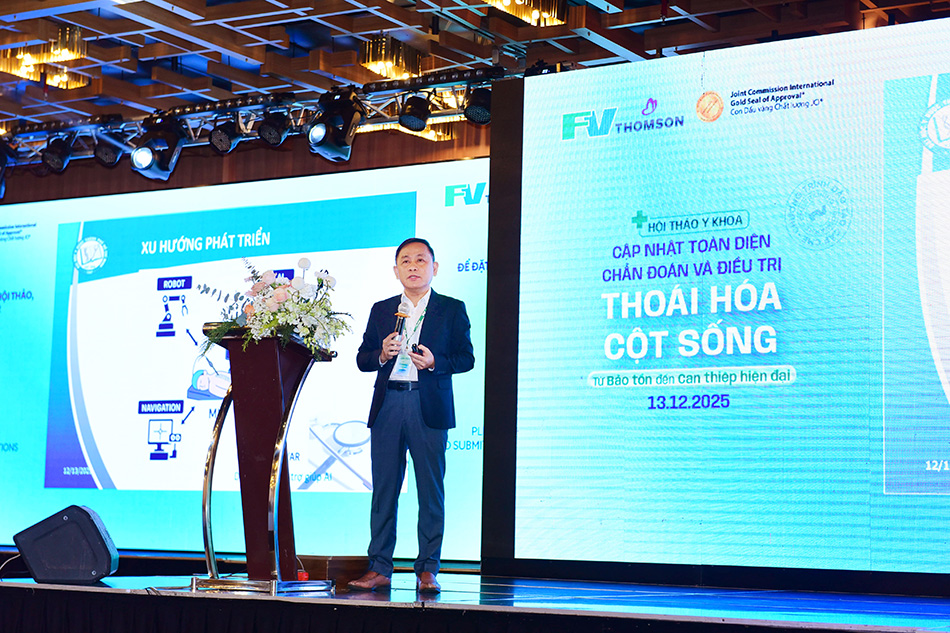
Dr Nguyen Cong, Specialist Level II, Senior Consultant, Neurosurgery and Endovascular Neurosurgery Department at FV Hospital
Bringing international expertise to the symposium, Huang Yilun, MBBS, MMed, MRCS, FRCSEd, FAMS, Director, Consultant Orthopaedic Surgeon, Total Orthopaedic Care & Surgery (Singapore), highlighted the importance of safety in endoscopic spine surgery.
While endoscopic techniques offer many advantages, including minimal invasiveness, faster recovery, and suitability for patients with comorbidities, not all degenerative spine cases are appropriate for this approach. Thorough imaging assessment, a strong understanding of three-dimensional anatomy, and the ability to recognise when to stop or convert to another technique are essential principles for safe endoscopic surgery.
“A good surgeon is not the one who manages complications best, but the one who prevents complications from the start,” Dr Huang emphasised.

Huang Yilun, MBBS, MMed, MRCS, FRCSEd, FAMS, Director, Consultant Orthopaedic Surgeon, Total Orthopaedic Care & Surgery (Singapore)
Also at the symposium, Dr Pham Hoang Manh, Specialist Level I, Senior Consultant at the Pain Clinic, FV Hospital, presented minimally invasive interventional pain management techniques as an important bridge between conservative treatment and surgery. Approaches such as epidural steroid injections, PRP, and radiofrequency ablation can help control pain, improve function, and enhance quality of life for patients who are not yet surgical candidates or are unable to undergo surgery.
Dr Manh highlighted that chronic pain is recognised as an independent disease, and that treatment goals should address not only structural pathology but also long-term pain control through a multidisciplinary approach.
Participants widely acknowledged the symposium’s strong clinical relevance and high practical value. Through the regular organisation of large-scale scientific conferences with the participation of both national and international experts, FV Hospital continues to strengthen its role as a platform for knowledge exchange, contributing to enhanced clinical expertise and higher standards of patient care in Vietnam.